Biomarkers
See the biomarkers hydra-genetics module documentation for more details on the softwares for the respective biomarkers. Default hydra-genetics settings/resources are used if no configuration is specified.
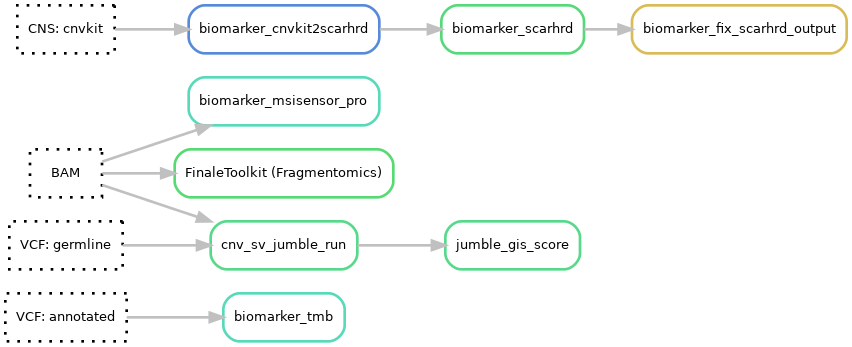
Pipeline output files:
results/dna/{sample}_{type}/tmb/{sample}_{type}.TMB.txtresults/dna/{sample}_{type}/msi/{sample}_{type}.msisensor_pro.score.tsvresults/dna/{sample}_{type}/hrd/{sample}_{type}.purecn.scarhrd_cnvkit_score.txtresults/dna/{sample}_{type}/hrd/{sample}_{type}.pathology.scarhrd_cnvkit_score.txtresults/dna/{sample}_{type}/biomarker/{sample}_{type}.predicted_gis.txtresults/dna/{sample}_{type}/additional_files/biomarker/{sample}_{type}.jumble_gis.csvresults/dna/{sample}_{type}/additional_files/biomarker/{sample}_{type}.gis.png
Tumor mutational burden (TMB)
TMB is a measure of the frequency of somatic mutations and is usually measured as mutations per megabase. The size of design of the exons is approximately 1.55Mb. However, by validating the TMB for GMS560 against Foundation One and TSO500 TMB the effective design size is adjusted to 1.19Mb. This is based on the slope (0.84) of the correlation between TSO500 data and the number of variants in the TMB analysis. The TMB is calculated using the in-house script tmb.py (rule) which counts the number of nsSNVs and divide by the adjusted design size. Variants must fulfill the following criteria to be counted:
Configuration
Software settings
| Options | Value | Description |
|---|---|---|
| af_lower_limit | 0.05 | Minimum 5% allele frequency |
| af_upper_limit | 0.95 | Maximum 95% allele frequency |
| af_germline_lower_limit | 0.47 | Filter out probable germline SNPs with allele frequency between 47%-53% |
| af_germline_upper_limit | 0.53 | Filter out probable germline SNPs with allele frequency between 47%-53% |
| artifacts | " " | Do not use artifact panel of normal |
| background_panel | " " | Do not use background panel of normal |
| db1000g_limit | 0.0001 | Germline filter of 0.01% population frequency |
| dp_limit | 100 | Minimum read depth of 100 |
| gnomad_limit | 0.0001 | Germline filter of 0.01% population frequency |
| nssnv_tmb_correction | 0.84 | (Number of variants - nr_avg_germline_snvs) * correction factor (correction factor = 1 / adjusted design size) |
| nr_avg_germline_snvs | 2.0 | Correction based on the average number of germline variants passing all filters |
| vd_limit | 10 | Minimum 10 observations of variant allele |
The result is the TMB calculated using nsSNVs. However, the variants passing all filters are also provided.
Result file
results/dna/{sample}_{type}/tmb/{sample}_{type}.TMB.txt
Microsatellite instability (MSI)
To determine MSS or MSI status of the samples the percentage of sites that have microsatellite instability are calculated using MSIsensor-pro v1.1.a. When more than 10% of the sites are instable the sample is determined to have MSI status. The program uses a panel of normal to determine the normal level of instability in the used sites.
Configuration
Reference
- Panel of normal for MSIsensor-pro (see references on how the PoN was created)
Result file
results/dna/{sample}_{type}/msi/{sample}_{type}.msisensor_pro.score.tsv
Homologous recombination deficiency (HRD) - in development
OBS! The Homologous recombination deficiency score is still under development
A homologous recombination deficiency score is calculated using scarHRD v20200825 using cnvkit segmentation files as input. The cnvkit panel of normal for HRD is created from a design file where the extra CNV-probes were removed as coverage in these regions tended to be more affected in low quality samples. The segmentation is sensitive to the estimated purity. Therefore, a score based on both the pathology and purecn estimated tumor content is reported. The cutoff for HRD is still to be determined but is somewhere around 50 which is slightly higher than the Myriad HRD score cutoff of 42.
Jumble GIS (HRD) score
Jumble also provides a Genomic Instability Score (GIS) which is a measure of HRD. The score is calculated based on various genomic features including LOH, TAI, and LST. The rule jumble_gis_score extracts the predicted GIS score for the sample's current tumor content (TC).
Result files
results/dna/{sample}_{type}/biomarker/{sample}_{type}.{method}.predicted_gis.txtresults/dna/{sample}_{type}/additional_files/biomarker/{sample}_{type}.jumble_gis.csvresults/dna/{sample}_{type}/additional_files/biomarker/{sample}_{type}.gis.png
Configuration
Reference for cnvkit
- Panel of normals created by cnvkit with extra CNV-probes removed (see references on how the PoN was created)
Software settings
| Options | Value | Description |
|---|---|---|
| reference_name | "grch37" | Reference genome |
| seqz | FALSE | Do not use seqz |
Result files
results/dna/{sample}_{type}/hrd/{sample}_{type}.purecn.scarhrd_cnvkit_score.txtresults/dna/{sample}_{type}/hrd/{sample}_{type}.pathology.scarhrd_cnvkit_score.txt
Fragmentomics
Fragmentomics analysis is performed using FinaleToolkit. It calculates various metrics related to cell-free DNA fragmentation patterns, which can be used as biomarkers.
Result files
results/dna/{sample}_{type}/fragmentomics/{sample}_{type}.end-motifs.tsvresults/dna/{sample}_{type}/fragmentomics/{sample}_{type}.mds.txtresults/dna/{sample}_{type}/fragmentomics/{sample}_{type}.interval-end-motifs.tsvresults/dna/{sample}_{type}/fragmentomics/{sample}_{type}.interval-mds.txtresults/dna/{sample}_{type}/fragmentomics/{sample}_{type}.frag-length-bins.tsvresults/dna/{sample}_{type}/fragmentomics/{sample}_{type}.fragment_length_score.txt
ctDNA Fraction Estimation
ctDNA fraction estimation is performed using Fragle. It calculates the ctDNA fraction based on fragment length proportions and machine learning models.
Configuration
Software settings
| Options | Value | Description |
|---|---|---|
| design_bed | " " | Target BED file containing captured regions |
| genome_build | "hg38" or "hg19" | The reference genome build |
| model | "T" or "R" | panel or WGS |
Result files
results/dna/{sample}_{type}/cnv/{sample}_{type}.ctDNA_fraction.fragle.csv
ctDNA Fraction Estimation (SNV and BAF based)
This method estimates the ctDNA fraction by combining two independent signals: 1. BAF (B-Allele Frequency): Analyzing the distribution of germline SNPs in regions with Copy Number Alterations (CNAs), specifically deletions and CN-LOH. 2. SNV (Somatic Nucleotide Variants): Identifying high-confidence somatic driver mutations and using their allele frequency (TC = 2 * AF).
The results for both methods are reported side-by-side in the final output.
Configuration
Software settings
The SNV filtering is highly configurable to ensure only high-quality somatic variants are used for estimation:
| Group | Options | Default | Description |
|---|---|---|---|
| CNV | min_germline_af | 0.1 | Min AF for germline SNPs |
| min_nr_SNPs_per_segment | 35 | Min SNPs for density calculation | |
| min_segment_length | 10000000 | Min segment length (bp) | |
| vaf_baseline | 0.48 | Reference bias correction | |
| SNV | max_af | 0.4 | Filter out likely germline (high AF) |
| max_gnomad_af | 0.0002 | Max population frequency | |
| min_mq | 40 | Min Mapping Quality | |
| min_qual | 40 | Min Variant Quality | |
| callers | ["vardict"] | Required callers |
Result files
results/dna/{sample}_{type}/cnv/{sample}_{type}.ctDNA_fraction.tsvresults/dna/{sample}_{type}/cnv/{sample}_{type}.ctDNA_fraction_info.tsv